For many transport companies, fuel consumption is a major expense within the Total Cost of Ownership of a truck fleet. Rising fuel prices are putting even more pressure on this expense.
Yet many transportation companies still don’t pay enough attention to their tires when it comes to saving fuel. Meanwhile, truck tires have a direct impact on diesel consumption. Rolling resistance, tire pressure, and tread pattern, in particular, determine how much energy a truck needs to keep moving.
Fuel consumption is a major expense in the transportation industry
Fuel costs directly impact the profit margins of transportation companies. Especially for trucks that cover many kilometers, every liter counts. A small difference in fuel consumption may seem insignificant per trip, but it quickly adds up across an entire fleet.
Several costs factor into the total expenses of a truck fleet, including drivers, maintenance, repairs, tolls, insurance, vehicle costs, and tires. Nevertheless, fuel remains a cost that transport companies have to deal with on a daily basis.
That’s why many companies are looking for ways to reduce fuel consumption. They often focus on driving behavior, route planning, and engine performance—all logical steps. But tires also deserve attention.
After all, a truck tire isn’t just a part that wears out. The tire also determines how much resistance the vehicle must overcome while on the road.
How Tires Affect Fuel Consumption
During every trip, various forces work against a truck’s motion. These include air resistance, gravity, mechanical friction, and rolling resistance.
Rolling resistance occurs because a tire continuously deforms at the point of contact with the road surface. The rubber does not fully spring back to its original shape. As a result, energy is lost as heat. The greater that energy loss, the more fuel the truck needs to keep moving.
That is why choosing the right tire is so important. A tire with low rolling resistance helps reduce fuel consumption, but it must be suitable for the truck, the axle configuration, the load, and the type of transport.
A tire for international transport has different requirements than one for regional operations, distribution, or construction transport. So the best choice isn’t always the tire with the lowest purchase price, but the one that delivers the best cost-per-kilometer ratio in practice. Mr. Truck Tires can advise you on this.
What exactly is rolling resistance?
Rolling resistance is the resistance that occurs when a tire rolls over the road surface. Every time the tire contacts the road, the rubber deforms. That deformation costs energy.
Some of that energy is lost as heat. As a result, the engine has to work harder to maintain the same speed. This leads to higher fuel consumption.
This is especially important for truck tires, because they carry heavy loads and cover many kilometers. Especially over long distances, even a small difference in rolling resistance can make a big difference on an annual basis.
However, rolling resistance must always be considered in conjunction with safety, traction, and wear. A truck tire must roll efficiently, but it must also brake well, remain stable, and be suited to the conditions in which the vehicle is driven.
What factors influence rolling resistance?
The rolling resistance of truck tires depends on several factors. Some factors are inherent to the tire itself. Others relate to usage, maintenance, and the vehicle’s daily operations.
Tire Pressure
Tire pressure that is too low causes the tire to deform more. This increases rolling resistance, causes the tire to heat up, and raises fuel consumption. It also causes the tire to wear out faster and increases the risk of damage or breakdowns.
Excessive tire pressure is also undesirable. The tire makes less contact with the road surface, which can result in reduced traction, a longer braking distance, and uneven wear.
That’s why it’s important to adjust tire pressure based on load, axle load, and usage. A heavily loaded truck making long trips requires a different check than a vehicle that primarily makes short distribution runs.
Tire Compound
A tire’s rubber compound determines how much energy is lost while driving. Fuel-efficient truck tires use compounds with lower internal resistance. This results in less heat loss and allows the tire to roll more easily.
That doesn’t mean every truck automatically needs the same tire. A tire designed for long distances has different characteristics than one intended for rougher conditions or frequent maneuvering.
Tread Pattern and Construction
The tire’s tread pattern and construction also play a role. Deep or aggressive tread patterns can result in more moving mass and greater deformation. Tires for long-haul transport are therefore often designed with a tread pattern that helps minimize rolling resistance.
In construction transport or heavy-duty applications, however, the emphasis is more often on traction, carcass strength, and damage resistance. In these cases, the lowest rolling resistance isn’t always the best choice.
Weight and Load
The heavier the load on the truck, the more the tires deform. This increases rolling resistance. Not only does the total weight matter, but also how the load is distributed across the axles.
Improper weight distribution can lead to extra wear, increased resistance, and less predictable handling. That’s why tire recommendations should always take into account the vehicle’s daily use.
Tire pressure is a simple way to save fuel
If you want to save fuel, you don’t always have to make an immediate investment. Proper tire maintenance can already make a big difference.
Tire pressure is one of the most practical factors in this regard. Incorrect tire pressure not only increases fuel consumption but also accelerates wear and tear and raises the risk of breakdowns on the road.
For transportation companies, it’s wise to check tire pressure on a regular basis—not just when there’s a problem, but as a standard part of maintenance and fleet management.
Want to check the correct tire pressure? Use our tire pressure chart as a handy reference. It provides guideline values by tire type, load index, and load capacity. Note: the manufacturer’s recommended pressure is always the starting point.
The EU Tire Label helps, but doesn’t tell the whole story
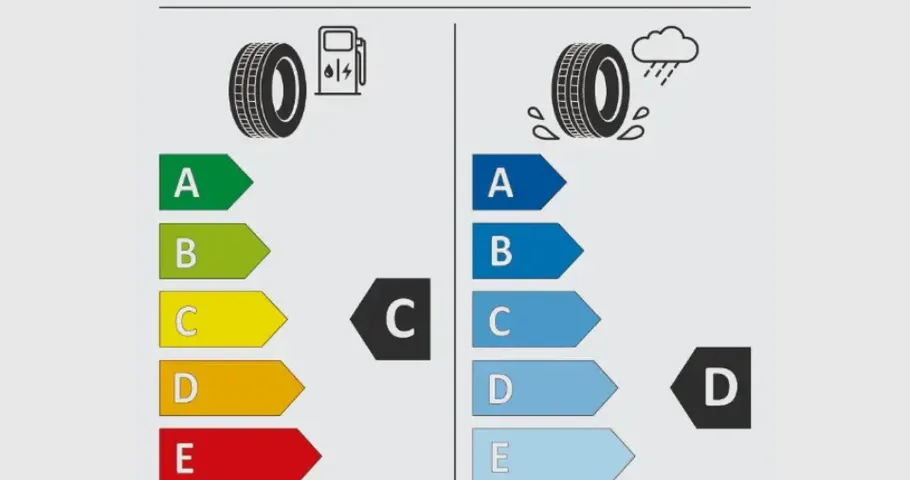
The EU tire label helps compare truck tires based on fuel efficiency, wet grip, and external rolling noise. For fuel efficiency, the label primarily considers rolling resistance. A higher label rating can therefore contribute to lower fuel costs and reduced CO₂ emissions.
However, the label doesn’t tell the whole story. A tire with a good fuel efficiency rating must still be suitable for real-world conditions. Consider the type of transport, the road surface, the weight, the axle position, and the driving profile.
Practical Tips for Saving Fuel with Truck Tires
Saving fuel with tires starts with a consistent focus on inspection, selection, and maintenance. It doesn’t have to be complicated, but it does require regular attention.
Check tire pressure regularly
Make tire pressure part of your routine inspection. Adjust the pressure based on load, axle load, and usage. This helps prevent extra rolling resistance, heat buildup, and unnecessary wear.
Choose tires based on application
Don’t automatically use the same tire for every vehicle. A long-haul truck has different needs than a vehicle used for distribution or construction transport.
Consider the cost per kilometer
Don’t judge tires solely by their purchase price. Also consider fuel consumption, service life, wear, downtime, and reusability.
Pay attention to wear patterns
Uneven wear often indicates incorrect tire pressure, misalignment, or a tire that isn’t well-suited for the application. Taking timely action prevents additional costs.
Involve drivers in inspections
Drivers are often the first to notice when a vehicle is handling differently—such as vibrations, pulling, reduced traction, or a heavier feel behind the wheel. Their observations help identify problems early on.
Seek advice for varied usage
Does your fleet drive different routes or carry varying loads? In that case, personalized tire advice from Mijnheer Truck Banden is well worth it. The right combination for each vehicle prevents you from making choices based solely on general specifications.
Want to learn more about fuel savings?
Would you like to know which tires are best suited to your operations, routes, and vehicles? Or are you curious about how much fuel your fleet could save?
At Mijnheer Truck Banden b.v., we’re happy to help you explore:
- Fuel-efficient truck tires;
- Optimal tire pressure;
- Rolling resistance and efficiency;
- Customized tire advice;
- Reducing TCO in transportation and logistics.